Pool contractor
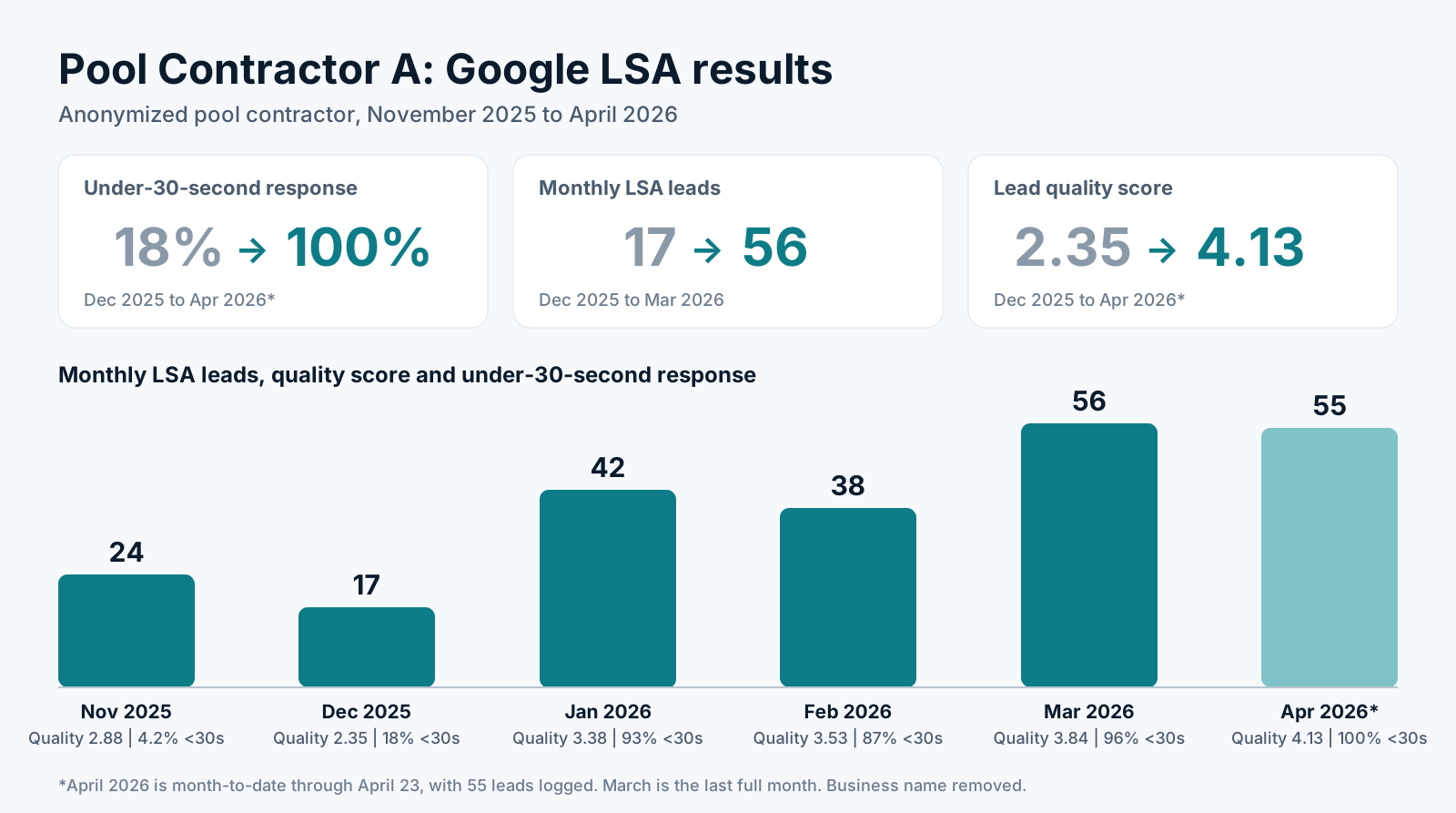
Pool Contractor A
- Under-30s response18% → 100%
- Monthly LSA leads17 → 56
- Lead quality score2.35 → 4.13

LSA Command case studies · for agency owners
Three pool contractors, six months of monthly Local Services Ads data each. The pattern was the same every time: answer every lead inside 30 seconds, rate every lead back to Google, and lead volume and lead quality climb together. Here is the data, and the playbook agencies use to repeat it across a client roster.
Leads answered within 30s
28%to100%
+72 ptsAverage of the 3 accounts, Dec 2025 → Apr 2026 (month to date)
Monthly LSA leads, combined
38to147
3.9xAll 3 accounts, Dec 2025 → Mar 2026 (last full month)
Lead quality score
2.43to3.87
+59%Average of the 3 accounts, Dec 2025 → Apr 2026 (month to date)
Combined from the three published case studies below. April 2026 runs through April 23. Pool demand is seasonal, and December is a slow month, so read the volume jump alongside response rate and lead quality, which don't rise on their own in spring. Measured from November instead, combined leads still grew from 53 to 147 (2.8x).
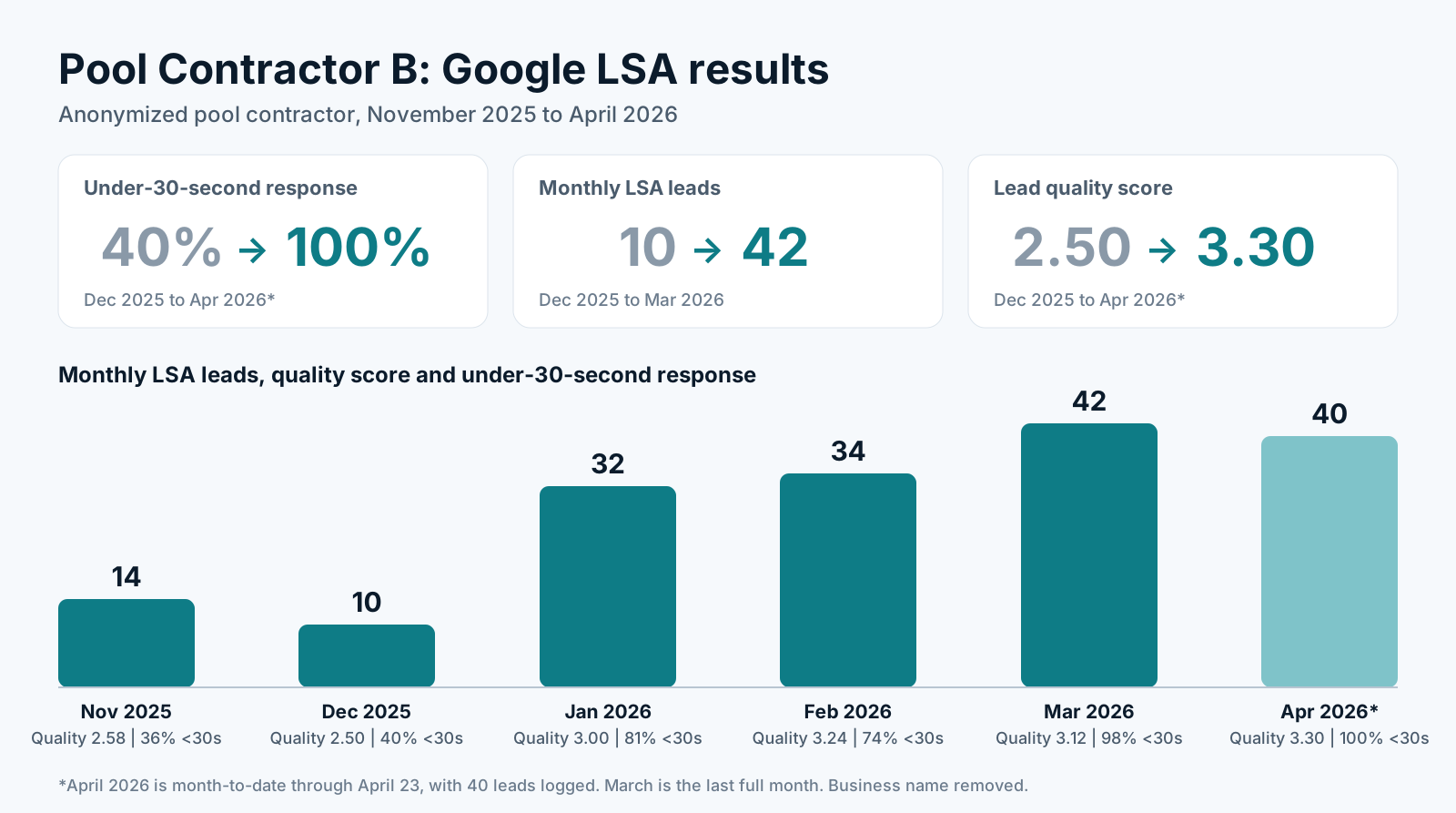
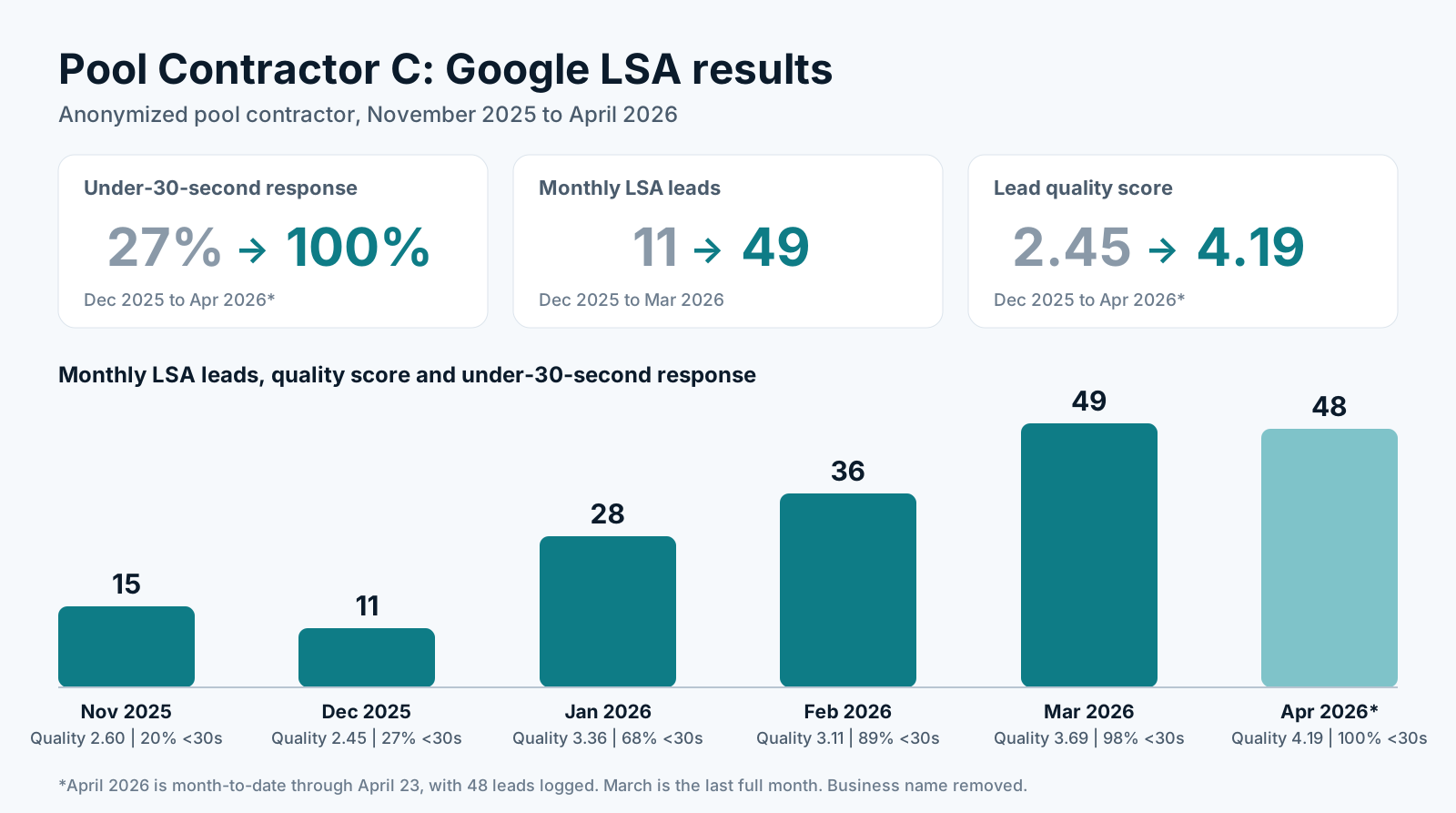
Between December and January, under-30-second response in these accounts jumped from 18% to 40% to 68% to 93%. LSA Command does four things on every account, and none of them depend on the client's team changing how it works.
The client's team rings first. If nobody picks up in 10 to 15 seconds, the call transfers and AI answers instantly, so the call doesn't become a missed call, which Google says can hurt responsiveness.
Replies go out instantly and are confirmed through the LSA API, so none of them silently fail to deliver.
Each lead is scored and rated, which teaches Google what a good lead looks like for this business. Spam and invalid leads get flagged for credit.
The account's response rate, lead quality, and lead volume are tracked monthly. Those are the same three numbers in these case studies, ready to send to the client.
Pool contractor
Pool contractor
Pool contractor
The results above came from one system applied the same way to each account. Here is how an agency runs it for every LSA client it manages.
Pull under-30-second response rate, lead quality score, and monthly lead volume for the last three to six months. Most accounts have one number that is clearly broken, and it is usually response rate.
Turn on the call flow and message-lead replies. In these case studies, response rate was the first number to move and the one the client noticed fastest.
Lead quality improves as Google learns from the ratings. It moves more slowly than response rate, so set that expectation with the client up front.
Send each client the same three-number report every month. A dip like Pool Contractor B's February shows up while it is still a small fix, not a cancellation.
Once a client approves, the before-and-after becomes proof for your next pitch, in the format you're reading now.
Yes. All three are real pool contractors whose results are already published on our homepage. We keep their names private to protect the businesses and their customers. Each case study is based on the original monthly report.
Yes, and we don't hide it. December is a slow month for pool companies, so part of the lead-volume jump into spring is seasonal. That is why each case study reports response rate and lead quality next to volume. Those two numbers don't rise just because it's spring, and they moved the most.
The reports were pulled on April 23, 2026, so April covers roughly three weeks. We show March as the last full month and label April as month-to-date everywhere it appears.
Yes. LSA Command is white-label ready: you run the system for your clients under your brand, and lead notifications and reports go to you and your clients. Book a 30-minute walkthrough to see the partner setup.
Yes. We only publish a client's numbers after the client and their agency approve it. More agency-run accounts are in that approval queue now.
Book a 30-minute agency walkthrough with our team. Bring one client's LSA account and we will pull its three numbers live: response rate, lead quality, and lead volume.